Introduction
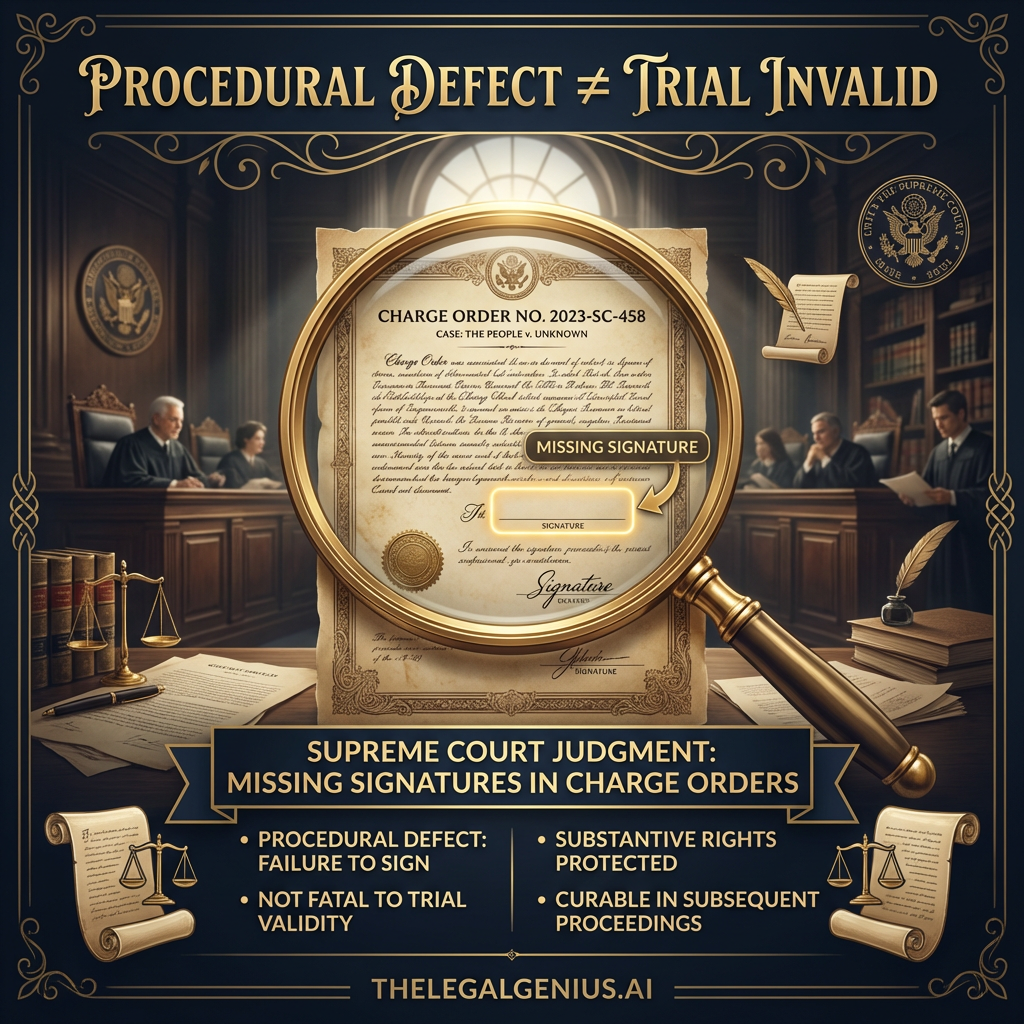
The Supreme Court of India has clarified an important issue in criminal trials. It held that a missing signature on a charge-framing order sheet is a curable procedural defect. This means the trial does not become invalid just because the judge did not sign the order.
This ruling gives much-needed clarity on how courts should deal with technical errors.
What is the Issue of Missing Signature in Charge Order?
In many criminal cases, lawyers raise objections about unsigned documents. One common issue is the missing signature on the charge order sheet.
The charge order is important because it tells the accused what charges they face. It is a key step under the Code of Criminal Procedure.
However, the Supreme Court has now made it clear that a missing signature alone is not enough to cancel a trial.
Supreme Court’s View on Curable Defect
The Court explained that a missing signature is a procedural irregularity, not a serious legal error. It becomes important only if it affects the rights of the accused.
The Court focused on one key question:
👉 Did the missing signature cause any real harm?
If the answer is no, then the defect can be corrected. The trial remains valid.
When Does a Missing Signature Matter?
A missing signature on a charge order may matter only in certain situations:
- If the accused did not understand the charges
- If the accused could not defend themselves properly
- If the error caused real prejudice
If none of these issues exist, the trial will not be affected.
Why This Judgment is Important
This ruling is important for the legal system. It prevents unnecessary delays in criminal trials.
Earlier, small procedural mistakes were often used to challenge cases. This led to delays and retrials. Now, the Court has limited such arguments.
The judgment supports a simple idea:
👉 Justice should not fail because of minor technical defects
Impact on Lawyers and Legal Practice
This decision changes how lawyers approach procedural errors.
Now, it is not enough to point out a mistake. Lawyers must show how the mistake caused actual harm.
This will lead to stronger and more meaningful legal arguments.
Role of Legal Research Platforms
Understanding such rulings is important for legal professionals. Platforms like TheLegalGenius.ai help users stay updated with the latest judgments.
They also help in analyzing whether a defect is procedural or serious. This makes legal research faster and more effective.
Conclusion
The Supreme Court has made it clear that a missing signature on a charge order is not a fatal error. It is a curable defect.
As long as the accused understands the charges and faces no prejudice, the trial remains valid.
This ruling strengthens the idea that substance matters more than procedure. It ensures that justice is not delayed due to minor technical issues.