
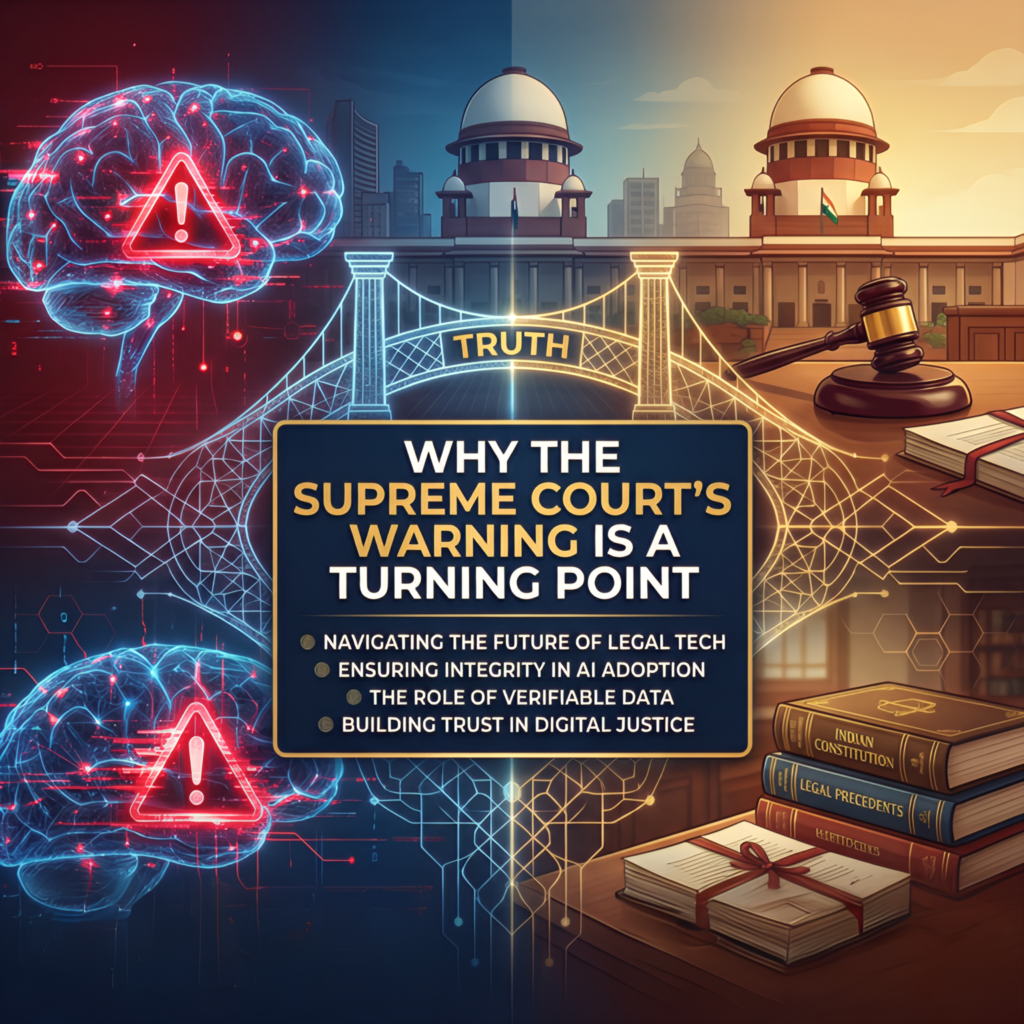
On February 27, 2026, the Supreme Court of India issued a stark warning that has sent ripples through the legal fraternity. A Bench led by Justices P.S. Narasimha and Alok Aradhe took serious note of a Trial Court relying on fake, AI-generated judgments, declaring that such an act is not a mere “error in decision-making” but constitutes professional misconduct.
As AI becomes a staple in modern law offices, this ruling marks a critical threshold: The era of “experimenting” with generic AI chatbots in legal research is over. The cost of an AI “hallucination” is no longer just a corrected draft—it is your professional license.
The Rise of the “Synthetic Judgment”
In the case before the Apex Court, a Trial Court in Andhra Pradesh had dismissed objections to an Advocate Commissioner’s report by citing four purported Supreme Court decisions. Upon closer inspection by the High Court, it was revealed that these judgments—complete with plausible-sounding citations—simply did not exist.
They were “synthetic” results, fabricated by a generative AI tool that prioritized linguistic fluency over factual truth.
Why Generic AI Fails the Bar Exam
Most popular AI tools (like ChatGPT or Gemini) operate on probabilistic models. When asked for a case law, they don’t “look it up” in a database; they predict the most likely next word. In the complex world of Indian law, this leads to:
- Fabricated Citations: Creating cases that sound real but don’t exist in SCC Online or Manupatra.
- Distorted Holdings: Taking a real case but inventing a legal principle that was never actually ruled upon.
- Outdated Law: Citing “bad law” that has been overruled or rendered obsolete by recent amendments.
The LegalGenius.ai Difference: Truth-First Architecture
At LegalGenius.ai, we watched this development closely. We built our platform specifically to solve the “Hallucination” problem that the Supreme Court is now penalizing.
Unlike generic chatbots, LegalGenius.ai is built on a Source-Grounded Architecture:
- Retrieval-Augmented Generation (RAG): Our AI does not “guess” citations. It is grounded in a verified, real-time database of Indian statutes and case law.
- Verifiable Citations: Every insight provided by LegalGenius.ai comes with a direct link to the primary source. If our AI mentions a case, you can click it, read it, and verify it instantly.
- Built for the Indian Context: We focus exclusively on Indian jurisprudence, ensuring that nuances of the Bharatiya Nyaya Sanhita (BNS) and specific High Court precedents are accurately captured.
Conclusion: Professional Responsibility Cannot Be Delegated
The Supreme Court has made one thing clear: The Lawyer of Record remains solely responsible for the content of their submissions. Technology-driven research is an advantage, but it requires a professional-grade tool.
The question for your firm is no longer “Should we use AI?” but “Is our AI grounded in truth?”
Don’t let a “synthetic” result jeopardize a real career. Experience the precision of AI designed for the integrity of the Indian courts.
Protect your practice with verified intelligence. [Start your 5-day free trial of LegalGenius.ai today]