
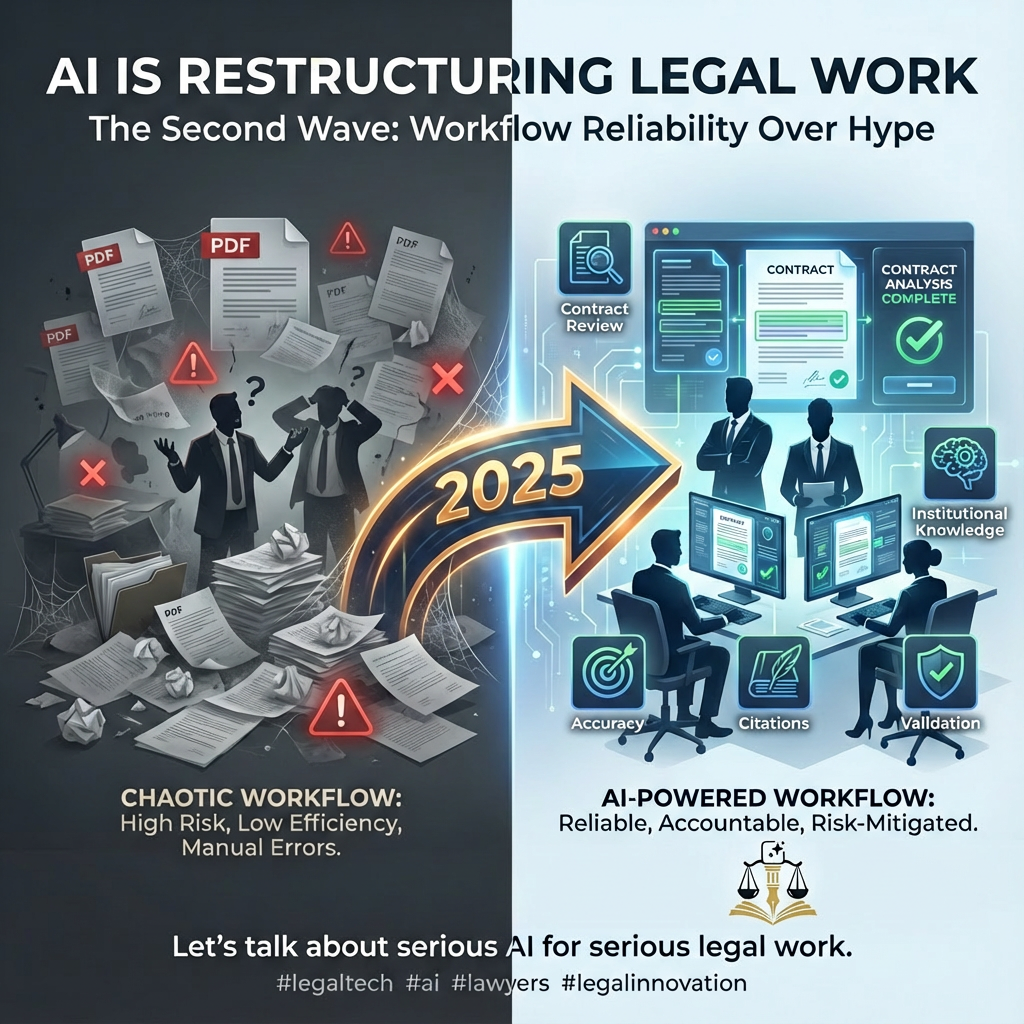
It is quietly restructuring how they work.
Big law firms are already rebuilding their workflows around AI assistants.
Smaller firms, in-house teams, and legal ops leaders are following — but with very different constraints around risk, accuracy, and accountability.
Since late 2022, interest in “AI for lawyers” surged, cooled with the hype cycle, and is now rising again.
This second wave is different.
It’s not about flashy demos.
It’s about workflow reliability.
What’s driving adoption today isn’t whether AI can draft or review contracts.
It’s whether AI can do it without creating malpractice risk.
Here are the real problems legal teams are trying to solve:
- Contract review that takes days instead of hours
- Institutional knowledge locked in PDFs and email threads
- Inconsistent clause interpretation across matters
- Answers without citations = unacceptable risk
- AI outputs that sound confident but can’t be trusted
In most industries, a hallucinated answer is an inconvenience.
In law, it’s sanctions, liability, and reputational damage.
That’s why the real question in 2025 is no longer:
❌ “Can AI draft contracts?”
It’s:
✅ “How is the AI constrained, cited, validated, and reviewed?”
This is exactly where TheGenius.ai changes the equation.
Instead of generic legal AI, TheGenius.ai is built around controlled intelligence:
Extracting and structuring contract knowledge with precision
Creating a trusted, queryable contract intelligence layer
Delivering answers grounded only in your documents
Making AI usable for real legal workflows — not just demos
AI won’t replace lawyers.
But lawyers who use unreliable AI will fall behind those who use governed, auditable, contract-aware AI.
The firms winning in 2025 aren’t chasing tools.
They’re redesigning how legal work actually gets done.
👉 Curious how serious legal teams are using AI without increasing risk?
Let’s talk.
Which part of the legal workflow do you think AI must get right before